Why Nature is the Ultimate Healer ?
We spend so much of our lives staring at screens, trapped in concrete boxes, and rushing to meet deadlines. But the moment you step outside and actually look around, everything changes. Nature doesn’t use an alarm clock, it doesn’t care about schedules, and it isn’t trying to impress anyone—yet it creates the most breathtaking moments on earth completely effortlessly.
If you’ve been feeling overwhelmed lately, here is a reminder of why the wild world outside is so genuinely beautiful and why we need it more than ever.
The Art of Unrehearsed Beauty
Nature doesn’t need a canvas or an editing app; its beauty is raw, alive, and constantly shifting.
The Daily Sunset Show: Think about the way a sunset looks. Fiery oranges melt into deep purples and soft pinks, changing by the minute. Nature puts on this spectacular show every single day, completely for free, even if no one is standing there to take a picture of it.
Perfection in the Imperfect: Unlike the things humans build, nature doesn’t rely on straight lines or perfect symmetry. A twisted, wind-blown tree gripping the side of a cliff isn’t ruined—it’s a masterpiece shaped by time and resilience.
It’s in Our DNA (The Connection to Our Roots)
Growing up in India, nature isn’t just “scenery”—it’s a part of our culture, our festivals, and our homes.
The Vibe of the Seasons: Think about the pure joy when the first monsoon rains hit the dry earth. That smell of mitti ki khushboo (petrichor) is something every Indian connects with instantly. It brings a wave of relief and happiness that feels deeply beautiful.
Signs of Life: For generations, our elders taught us to respect trees, rivers, and mountains. When we see lush green fields or a flowing river, our brains automatically recognize it as a place of peace, life, and abundance.
Nature is the Ultimate “Sukoon” (Peace)
Our cities are incredibly noisy—horns honking, people rushing, constant chatter. Nature gives us that rare, priceless thing called sukoon.
The Sound of Silence: When you go to a hill station like Shimla, Manali, or Ooty, and you just sit under the pine trees, the silence isn’t empty. The sound of the wind rustling the leaves or a river flowing over smooth rocks acts like a natural meditation. It instantly washes away all the dramebaazi and stress of daily life.
No Filters Needed: Nature doesn’t try to look good for Instagram. A mountain looks majestic even on a cloudy day, and a sunset is beautiful even if nobody is standing there with a phone camera. That raw, honest beauty is what captures our hearts.
It Teaches Us to Slow Down
We live in a world where everyone wants success, results, and answers instantly. Nature teaches us the beauty of sabar (patience).
Slow & Steady: A river doesn’t cut through a huge rock because it’s super strong today; it does it because it keeps flowing day after day, year after year. Watching the seasons change slowly reminds us that good things take time and you can’t rush growth.
The Comeback: Even after the harshest winter or a bad storm, spring always comes back with fresh green leaves. It’s a beautiful, real-life reminder that no matter how tough our current situation is, we can always bounce back and start fresh.
When your mind is constantly overloaded, it directly triggers four big things: mood swings, irritation, arrogance, and a completely blocked mindset.
But the moment you step away from the concrete jungle and spend even 30 minutes in a quiet, green park or near water, nature works like a total reset button. Here is exactly how nature fixes our heads and alters our worst moods:
Stopping the Non-Stop “Chidchidapan” (Irritation)
When you are stuck inside four walls all day, every little thing starts annoying you. The internet is slow? You get angry. Someone cuts you off in traffic? Your blood boils. This constant irritation happens because our brains are suffering from mental fatigue.
How Nature Fixes It: Nature has what psychologists call “soft fascination.” Watching leaves rustle in the wind, seeing a bird build a nest, or watching rain fall doesn’t require hard mental focus. It gives your overworked brain a chance to rest. The moment your brain catches a break, that constant undercurrent of chidchidapan just evaporates, and you instantly feel lighter.
Smashing the Ego and Arrogance
When we achieve a little bit of success, build a nice house, or buy an expensive car, a sense of ghamand (arrogance) can quietly creep in. We start thinking we control everything, and we become rigid, impatient, and hard to deal with.
Shifting a Blocked Mindset to Fresh Perspectives
When you are stressed, your thinking becomes incredibly narrow. You get stuck in a loop of negative thoughts, feeling like your life is going nowhere and your problems are permanent.
How Nature Fixes It: Nature operates on sabar (patience) and resilience. A river never stops flowing just because a huge boulder blocks its path; it simply carves a beautiful way around it. Even after a harsh autumn leaves the trees completely bare, they patiently wait for spring to bloom again. Watching this survival loop reminds your subconscious mind that your current problems are temporary, opening up your mind to new, creative solutions.
The Dark Side of Nature: Why the Ultimate Creator is Also the Ultimate Destroyer
It Attacks Without Warning (Dhoka De Deti Hai)
The scariest part of nature’s dark side is that it gives zero time to react. You can check all the modern weather apps on your smartphone, but nature operates on its own timeline.
Flash Floods & Cloudbursts: Imagine a beautiful, sunny day trekking in Himachal or Uttarakhand, and out of nowhere, a cloudburst happens upstream. Within minutes, a dry riverbed turns into a roaring wall of muddy water, swallowing cars, hotels, and roads like they are made of cardboard.
The Silent Bolt: A sudden afternoon thunderstorm looks beautiful from a balcony, but in our open fields and villages, it brings deadly lightning strikes. In a microsecond, a single bolt carrying millions of volts can strike without a sound, taking lives before anyone can even run for cover.
Its Power is Entirely Blind and Unstoppable
When the dark side of nature takes over, no amount of human engineering can save us. It doesn’t look at who is rich or poor; it just wipes the slate clean.
Landslides & Earthquakes: When the earth shakes or heavy rains loosen the mountain soil, entire hillsides just collapse. Massive boulders crush highways, blocking thousands of people and cutting off entire valleys from the rest of the world.
Coastal Devastation: Look at the cyclones hitting our coastal areas like Odisha or West Bengal. Winds howling at 200 km/h don’t just blow away roofs—they uproot ancient banyan trees, tear down massive iron electric poles, and push the sea miles into human territory, flooding everything with saltwater.
It Hosts Silent, Lethal Monsters
The dark side isn’t just about massive natural disasters; it’s also hidden in the quiet, daily survival battle of the wild where humans are incredibly weak and vulnerable.
The Slithering Threat: In India, walking through high grass or a village path after dark can be a gamble with life. Creatures like the Spectacled Cobra or the Russell’s Viper don’t hunt humans, but if you step on them in the dark, they strike with lethal venom that can shut down your organs in hours.
The Jungle Rules: Step deep into the forests of Madhya Pradesh or the Sunderbans, and the hierarchy changes instantly. To a Royal Bengal Tiger or a leopard, we are not civilised people with corporate jobs; we are just slow, weak, and defenseless prey.
Extreme Elements Can Simply Shut Down Your Body
Sometimes nature doesn’t kill you with a sudden impact like a flood or an earthquake; it just turns up the dial on the climate until the human body can no longer cope.
The Deadly Indian Heatwave: During May and June, North India literally turns into a furnace. When temperatures cross 47°C and the Loo (boiling hot wind) blows, it creates a silent emergency. Severe heatstrokes can kill a healthy human within hours through extreme dehydration.
The Freezing Void: On the other extreme, if you get stranded in the high-altitude passes of Ladakh or the Himalayas without the right gear, the extreme cold and thin air will trigger frostbite and altitude sickness, putting a human to sleep permanently.
Conclusion.
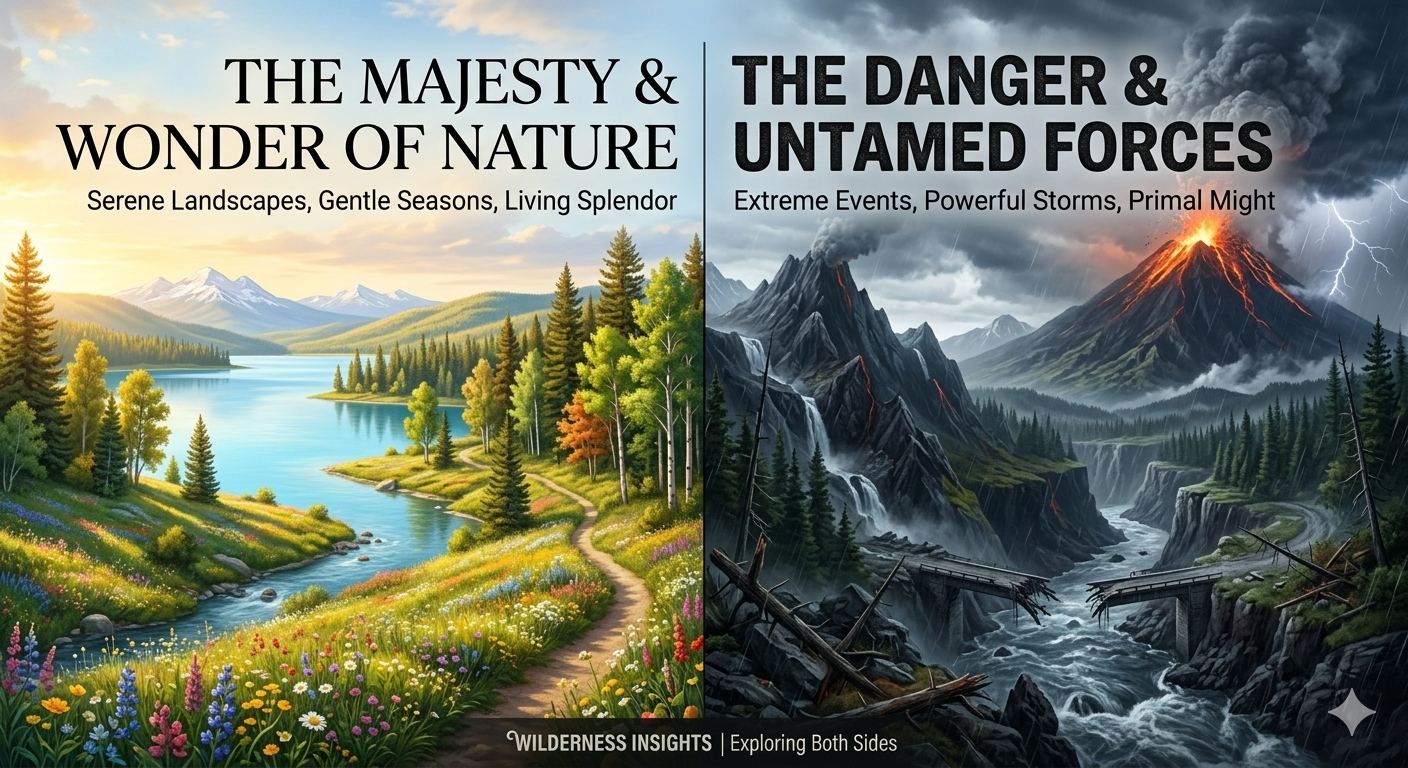
The Healer (Beautiful Nature): On one hand, nature is our ultimate escape. When life in the city gets too loud and our heads are frying with stress, nature gives us that pure sukoon (peace). It fixes our mood swings, kills our daily irritation, and treats us to stunning sunsets and the magical smell of monsoon rain completely for free. It is a gentle mother that cures our souls.
The Destroyer (Dangerous Nature): But on the other hand, we can’t afford to be blind to its dark side. When nature loses its temper, it shows us its raw fury. A sudden cloudburst washing away roads in the hills, a savage cyclone tearing up the coast, or a quiet venomous snake waiting in the dark—it strikes without warning. In front of its blind power, our fancy technology, concrete buildings, and big egos don’t stand a chance. It puts us in our place (aukat) in a split second.
The biggest mistake we humans make is thinking we are the bosses of this planet. We are not. We are just temporary guests living here at the mercy of the elements.
Nature doesn’t need us, we need nature. If we treat her with arrogance, greed, and disrespect, her dark side will show no mercy. But if we approach her with humility, care, and deep respect, she will remain the most beautiful, healing home we could ever ask for.
So, the next time you stand in front of a gorgeous mountain or sit by a roaring ocean, don’t just click a photo for social media. Take a deep breath, leave your phone aside for a second, and bow your head to the sheer, unstoppable power of the wild world around you.
Thank You



Leave a Reply